[##This is entirely appropriate, of course, given the story of citizen Nicolas Chauvin's life and the origin of the word!]
Stephen, Mark B and David joined us for the game.

Our set-up for Friedland, Russians at right. Friedland is in the top-right of the photo, the Sortlack wood is in the foreground.
Friedland, the battle in which Napoleon's Grande Armée completely defeated Bennigsen's Russian army, leading to the end of the campaign of 1806–07 and the Peace of Tilsit is a tricky one to recreate on the wargames table.
The battle was precipitated when four squadrons of French hussars of Lannes' advance guard, which had reached Friedland around 15:00 on 13th June, were forced out of the town by Gallitzin's vanguard of the Russian army. Bennigsen, the Russian C-in-C, learned from some of the hussars whom Gallitzin's troops had captured that he faced only Lannes' isolated corps. Seeing an opportunity to complete the destruction of Lannes' corps, which had been mauled at Heilsberg four days earlier, he came up with the hair-brained scheme of crossing the Alle River, defeating Lannes, then re-crossing before Napoleon and the main French army arrived.
The Russian army began the crossing around 20:00 on the 13th. Bennigsen ordered three pontoon bridges to be thrown across the Alle to increase the number of crossings, but the Russians still had to negotiate a considerable funnel created by the river crossings, the confines of Friedland, the wide bend in the Alle to the south and its tributary the Millstream and pond to the north (see map below). By 03:00 on 14th June 10 000 of them had crossed the river and it was not until 08:00 on the 14th that Bennigsen had 40 000 on the west bank of the river and could prepare a general assault on the French.
In a classic piece of advance guard generalship Lannes, initially with around 18 000 men, increasing to around 40–45 000, held off over 60 000 Russians. Ably assisted by his subordinate commanders, especially Grouchy, Nansouty and Oudinot, Lannes used a combination of deception and stiff resistance to first bluff the Russians into thinking that his force was larger than it was and then to blunt the uncoordinated Russian attack.
Such 'trickery' is difficult to recreate on the wargames table.
The easy solution is to play the game from around 17:30 on 14th June by which time Napoleon, along with I Corps, VI Corps and the Imperial Guard, had arrived and, determining that he would not "catch the enemy making a mistake like this twice", launched what was to be the decisive attack.
The trouble was that I wanted to wargame the entire battle.
The trick then was to design a scenario that would give the Russians a chance to do better than history while preventing them from bringing all of their strength to bear on Lannes' force before French reinforcements arrived.
The trick then was to design a scenario that would give the Russians a chance to do better than history while preventing them from bringing all of their strength to bear on Lannes' force before French reinforcements arrived.

Map of the table-top at the commencement of the game, 08:00 14th June.
We began the scenario at 08:00, when Bennigsen had most of his army across the Alle and an hour before he launched a somewhat piecemeal attack on Lannes' position. I hoped that the restrictions on the Russian command—all divisions beginning the game with defend orders and only having two aides de camp for the transmission of orders, combined with their initial, historical deployment, would slow the attack of the Russian divisions to prevent them over-running the small French force, but not prevent them from attacking and thus having a chance to win.
The only way we'd find out if it would work was to play the game!

The next five photos show the table-top at the commencement of the game.


Not wishing to be hemmed in against the table edge, Lannes ordered his troops forward.


As Petre reported, apart from the Dombrau wood, the northern part of the battlefield was ideal for cavalry.

Grouchy sent his dragoons against Uvarov's troopers.
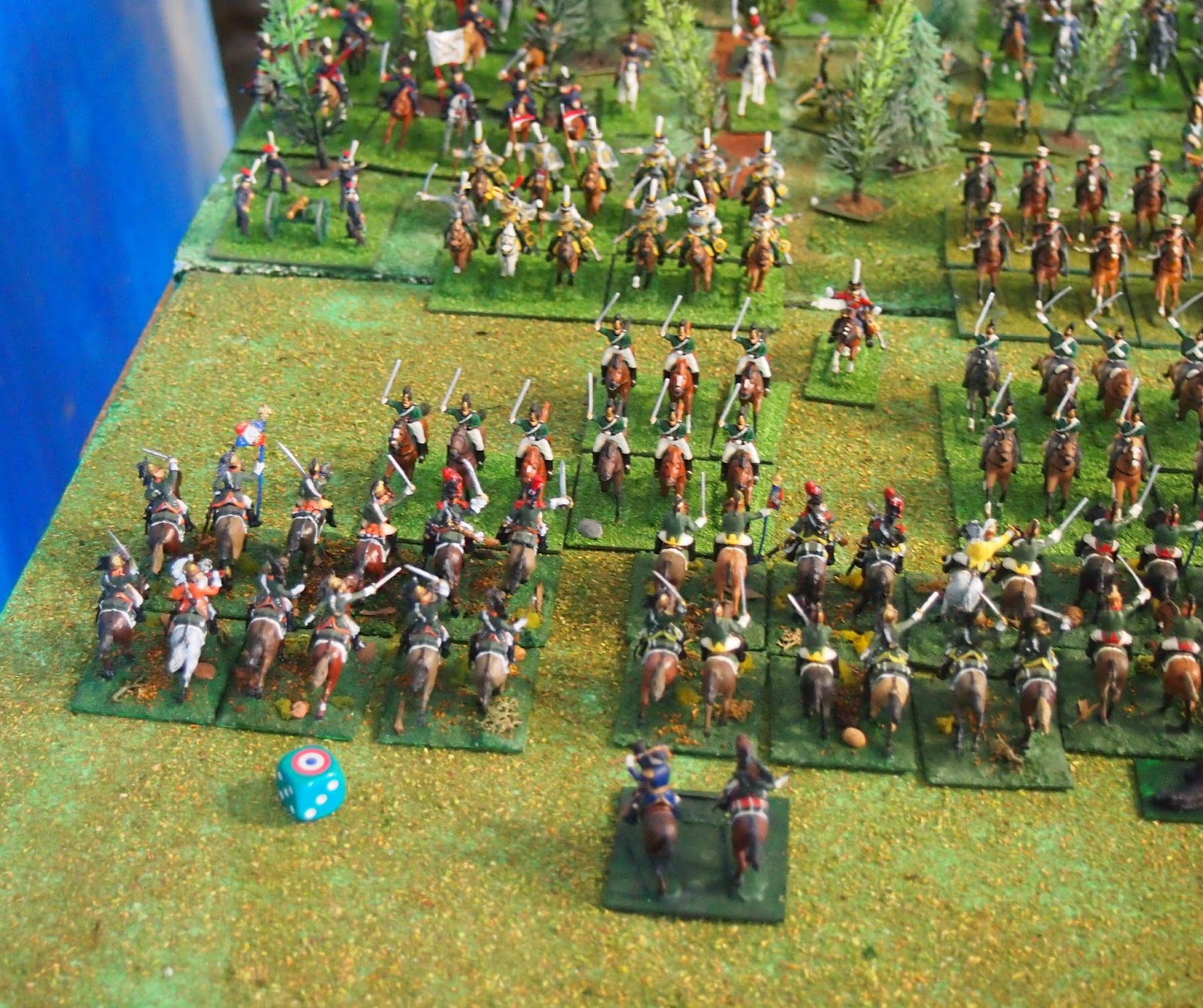
The French got the better of these encounters (Stephen was on target).


The French also won the follow-up mêlée.


Our eye in the sky looks over the battlefield, from north to south.


The Dambrau wood was alive with Cossacks!
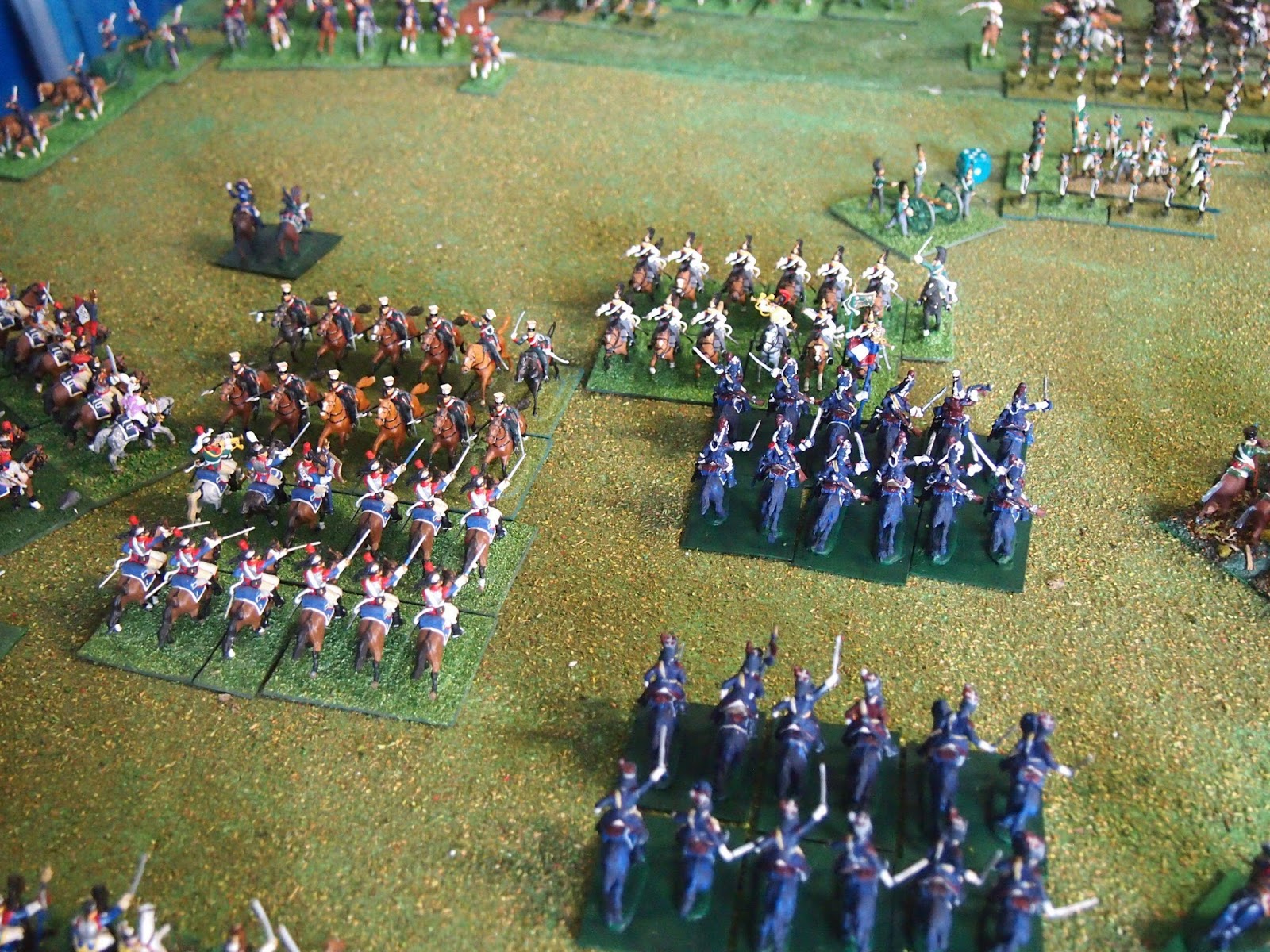

These ones are 1-all, ...


but the follow-up (breakthrough) combat goes the way of the French heavies.


Trying to emulate their heavy countrymen, Carriere's 2e/4e hussars (heavily disguised as the 9e) saw the opportunity to charge some Russian infantry. The infantry formed square and sent them packing.


In the south, Biggowouth's jäger emerged from the Sortlack wood, were attacked by the 6th grenadier battalion, but sent them reeling to in retreat.


Losing control and forgetting the lesson from their hussar brothers, Carrier's chasseurs charge Russian infantry in square, with the expected result!


In these six photos we'll take a fly around the table, taking off from the north-west (view from the French lines), heading south, then turning to look north, proceeding along the eastern edge and ending, past Friesland and ending with the north of the Russian lines.


Zooming back in at this point, the cavalry action continues, the French horsemen once again getting the better of the encounters.


success against jägers,

and against line infantry,

but not the combination of those Grodno hussars, back for more, and their jäger mates!

That was the end of the 10:00 turn. The French advance guard have been doing well against limited Russian attacks, but there are still plenty of Russians on the other side of the field, whose attacks are beginning to co-ordinate. Where is the Emperor with the rest of the Grande Armée?!


This brings us to the end of part one in which we played five turns. The stage is set for a most engrossing second part. With the scenario able to run until the end of the 22:00 turn (up to 29 thirty-minute turns) this one will likely go for at least three of our 'sessions'.

Not on the table, but here are some more of Julian's marvellous scratch-built buildings.
References used in compiling scenario
- Chandler, D (1966) Part Nine Winter War, 53. The Battle of Friedland. In, The Campaigns of Napoleon. Weidenfeld & Nicolson, London. 1993 paperback edition. pp. 572–585.
- Esposito, VJ and Elting, JR (1999) Military History and Atlas of the Napoleonic Wars. Greenhill Books, London. 2nd Edition edition. Maps 78–82.
- Hourtoulle, F-G and Jouineau, A (2007) From Eylau to Friedland: 1807, The Polish Campaign. Translated by A McKay. Histoire & Collections, Paris, France. pp. 80–90.
- Kiley, KF (2007) Let Not One Escape. In. Once There Were Titans: Napoleon's Generals and Their Battles, 1800-1815. Greenhill Books London. pp. 145–155.
- Mikaberidze, A (2015) Russian Eyewitness Accounts of the Campaign of 1807. Frontline Books (an imprint of Pen & Sword Books Ltd), Barnsley, South Yorkshire, UK. pp. 254–274.
- Petre, FL (2001) Napoleon's Campaign in Poland 1806-1807. First Published 1907. Wren's Park Publishing, Barton-under-Needwood. 2001 edition. pp. 311–337.
- Summerville, C (2005) Napoleon's Polish Gamble: Eylau & Friedland 1807. Campaign Chronicles (Ed. C Summerville). Pen & Sword Books Limited, Barnsley, South Yorkshire, England. pp. 124–141.

