Friday, 14 December 2012

It Pays To Be A Wascal Wo-man


As mentioned in the last game report, the second of our non-Napoleonic outings in this little sojourn from the real stuff was another game of Warhammer Ancients, which we played on 2nd December—a strange way for a Napoleonic-focussed group to pass the 208th anniversary of the Coronation and 207th anniversary of Austerlitz! Still, there will be plenty more Napoleonics to come, especially in 2013.
As with our ANF Australia Day game, Mark set-up a simple points battle, this time of Republican Romans against Britons. Only two of the three amigos were in attendance. Mark gave me the option of which side to choose. Remembering some bad experiences with Dacians using WRG 7th Edition rules in the 1990s at the NWS, I took the Romans since, “I probably have more of an idea of what to do with them!”
We decided to follow the sequence of play from go to woe, so began by placing our units, alternating, one at a time. There were no surprises at the end of this, each of us adopting a classical deployment with infantry in the centre, mounted troops on either flank and skirmishing troops to the front.

Troop deployment, Romans nearest camera

Deployment near complete

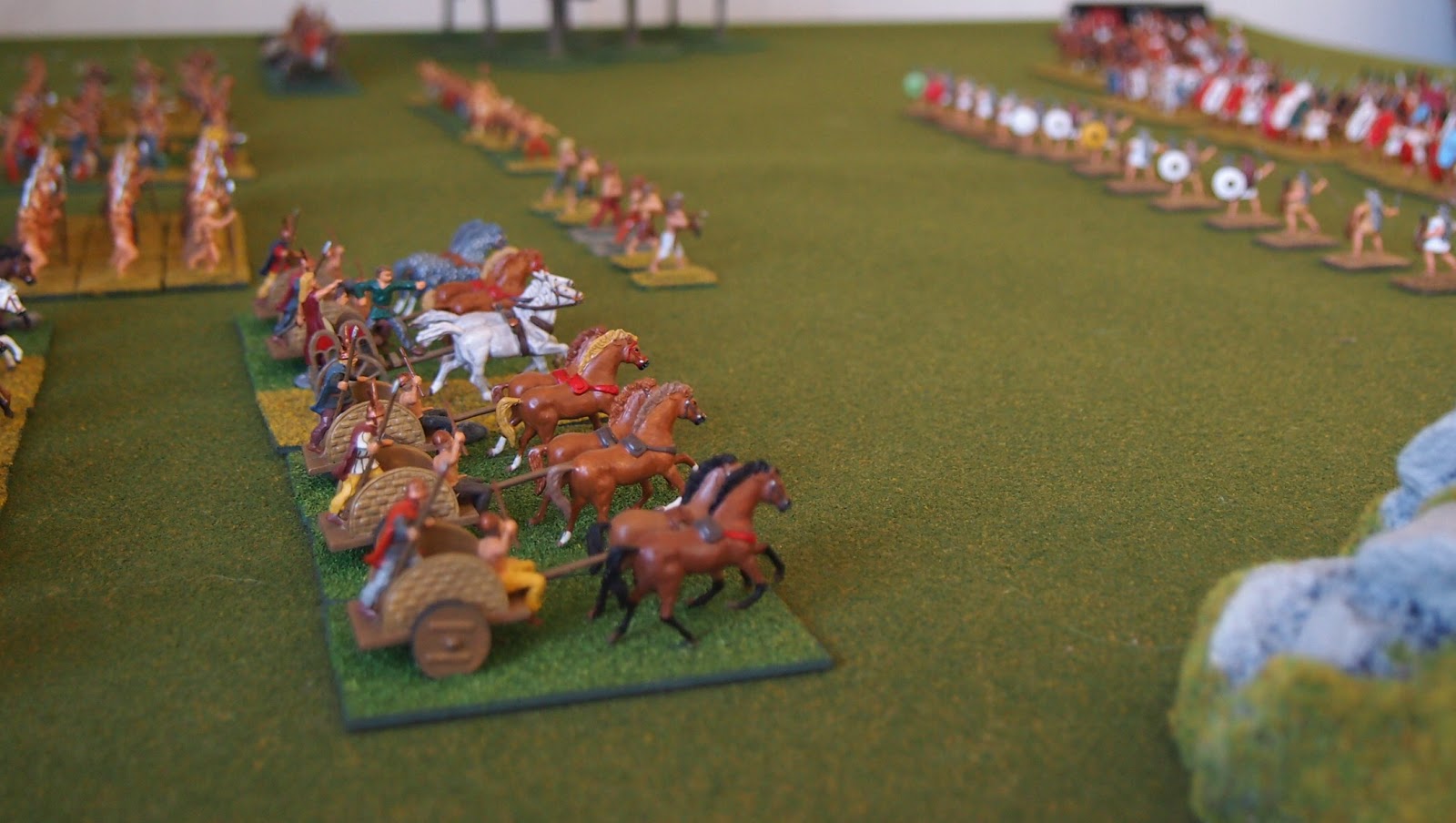
Britons deploy the last of their chariots

View from right of the Britons

Romans viewed from their left
Our correspondent on the scene takes up the story...
The tribesman were uncertain of the wisdom of facing the Romans in open battle, preferring to set up ambush in the rocks and woods and to wear the invaders down, but the charismatic Chief Mark was persuasive. He was supported in his pleas for action by the enchanting and fierce warrioress Boudica and by assurances from the druid Aidan that the omens were good. Thus inspired and assured the united tribes went into battle to crush the invaders and to drive them into the sea.
Confident in the strength of their warbands and wishing to use their chariots to good effect the Britons selected an open clearing, broken only by a small, rocky hill to their right and with small woods on either side. The accursed Romans faced them across the plain, but the standoff lasted only a short time as both armies advanced.


Turn 1

The armies advance...

Chief Mark in the centre of the warbands
As the armies closed, the skirmishing troops from both sides exchanged ‘fire’ with javelins and slings. This went slightly in favour of the Britons, building their confidence for the coming mêlée.
Turn 2

Britons get better of early skirmishing (fallen figures staged for the camera!)

Roman cavalry charge Boudica's chariots...

... and are driven off

Chariots pursue and crash into Italians
On left flank, the Romans sent a unit of equites against the leading unit of British chariots. This did not go well, as two casualties to zero saw the equites run. Fortunately the rest of the army ignored this (all passed panic test), but the chariots pursued and crashed into one unit of Italian allies. Oh dear, thought Julius Pescatore, here we go again...
As the feeling of dread was coming o’er him, Pescatore was shaken back to his senses when... the chariots broke! His pleasure at seeing this turned to absolute delight as, seeing the flight of the chariots and their warrioress, Boudica, the two closest units, a warbands and the naked fanatics panicked and ran, leaving a huge hole in what used to be the Briton’s right flank. [The real Mark was not having a good day with the dice]


Turn 3

Chariots and Italians in mêlée

The chariots break!
Wishing to keep the line intact, Julius Pescatore attempted to halt his Italian allies, but, filled blood lust and excitement at their victory, they charged headlong after the chariots. “How quickly good things can come undone,” thought Pescatore. He need not have worried, the Italians smashed into the second unit of chariot-riding Britons and promptly put them to flight too. Buoyed by this success, Pescatore sent his right-flank Italian allies, spearmen and cavalry, against the Briton’s left.
Panic!
Italians pursue...
...attack and defeat another unit of chariots
Leaving them in control of the field
Another view of same
Meanwhile, on the Britons' left, the remaining Italians attack
Meanwhile, the main bodies of both armies advanced to contact. Druid Aidan urged the leading warband on and they swiftly accounted for the Roman velites, pursuing on to crash into the lines of the legions: vulnerable hastati in the front rank, supported by princeps and triarii.
Turn 4
Druid Aidan leads warband against velites which are brushed aside
But the hastati drive them off
Vulnerable, who said that? Inspired by their Italian allies, the hastati stood firm, sending the druid and his warband the way of their be-charioted friends. Chief Mark tried in vain to halt their flight, but to no avail. As the druid and his warband streamed past him, the second unit of Roman hastati crashed into and overcame the army boar banner bearer and escort. The Chief now stood alone, facing the on-coming Romans.

Hastati (top left) attack the Britons' army banner
There was a glimmer of hope for the Britons though. After several rounds of mêlée, the  Roman right flank was opened up as the Italian spearmen and cavalry were both defeated in their combats. The glimmer was but brief and rapidly extinguished as Chief Mark and his bodyguard were attacked by the hastati, fresh from their victory over the army standard and guard.


A victory for the Britons on their left flank; Italian spearmen beaten
and the cavalry too
Turn 5
Fresh from their victory over the banner party, the hastati attacked the Chief and his bodyguard

He who fights and runs away... not wishing to end his life in defeat, the Chief was soon following the bulk of his army and fleeing the field of battle. The Romans were now free to deal with the remaining Britons in force.
He who fights and runs away...
Following closely on the heals of fleeing warbands 
Druid Aidan lead the retreat

Sometimes it is not good to be King
Defying the odds, the last warband stood firm, determined to cover the retreat of their feeble countryman and salvage honour. It was a piece of foolish bravery that could only end one way...
The last war band
Turn 6
Last stand
Romans move in for the kill
Thus ended a somewhat strange and completely decisive game in which the Britons were neither brave nor mad... in equal measure!
Epilogue: As the Roman army drank a toast to their all-conquering Italian allies, Aidan the druid was last seen feeding the crows; or more correctly, as crow food!

The Italian stallions
(Next game: Ranger Danger in 15 mm. Mon dieu Msr Rosbif, that is a change of era and scale!!!!)

Sunday, 9 December 2012

Old Leipzig Town: Wargaming Leipzig 2013 (2)


Last week, the ‘three amigos of the ANF gathered together for the last time for 2012 to discuss some town planning. The topic of our musings: representing the town of Leipzig in our bicentennial game.

We had a number of town plans including two from supplied the ‘library’ of Julian’s long-time wargaming friend Tim and another from Pigeard’s wonderful book “Leipzig : La bataille des Nations (16-19 octobre 1813)” which I have acquired recently, plus descriptions from Pigeard, Petre (still one of the best on the subject) and Lieven. In the  old chestnut of ‘realism’ vs practicality we leant strongly towards the latter, as we usually do, thus rapidly and painlessly agreed on our approach.

We have opted for a stylised version covering 400 x 400 mm^2 on the table, which will be 800 m x 800 m once scaled. This is about right for the area occupied by the old city and will give a suitably impressive BUA on the tabletop, while still being practicable.


Town plan for Leipzig showing sections of old wall (dark brown outline), roads (shaded brown), gates (denoted by the openings), two churches (denoted by crosses), university (bottom RH corner) and the Börse (centre RH side).

As with all of our villages, towns and cities, Leipzig will be constructed on 100 x 100 mm^2 squares, thus affording flexibility and transferability for future games. These 16 squares provide sufficient area for some distinct features and buildings such as two churches, a university, the Börse, the Rathaus, the town square, some large buildings, terraced buildings and smaller buildings, plus sections of the dilapidated old wall and the four roads in with their key gates.

It's now over to our architect and builder-in-chief, Julian “Wren”, who will manage the design and construction. No doubt he will take our simple plan and produce the same wonderful results that he did with the Borodino church, the Chernostrov Monastery and Maloyaroslavets town—which will make its debut in our re-run of that game in early 2013.

Julian's excellent Maloyaroslavets town (not shown in place, but merely placed on the table)
Not letting any grass grow under his feat, Julian has sent us a photo, taken from his overseas solo "sweat-shop", showing some of the early stages of construction. One marvellous aspect of this is the top quality materials that Julian utilises. His works of art are all produced from recycled boxes—boxes that formerly contained dog biscuits being a preferred material! I look forward to posting updates as the construction progresses.

Construction of the Rathaus, fresh from Julian's overseas solo "sweat-shop"
Meanwhile, painting the necessary troops is continuing...


Sources mentioned above

  • Lieven, D (2009) Russia Against Napoleon: The True Story of the Campaigns of War and Peace. Penguin Books, London, England. 618 pp.
  • Petre, FL (1974) Napoleon's Last Campaign in Germany, 1813. First Published 1912. Arms and Armour Press, London, UK. 403 pp.
  • Pigeard, A (2009) Leipzig : La bataille des Nations (16-19 octobre 1813). Napoleon 1er Editions, St Cloud, France. 82 pp.

Sunday, 2 December 2012

A Change of Era: Warhammer Ancients

Apparently there are periods other than Napoleonic?! We at the ANF like to dabble occasionally in other eras for a bit of light relief and to remind ourselves why our “first love” is the “real stuff”!
The particular dalliance with another period of history belatedly reported in this post was a bit special as it marked the beginning of what we hope will become a tradition; the ANF Australia Day Game. As we prepared for our epic Eylau game in early February 2012, we scheduled a bit of such ‘light relief’ in the form of a game of Warhammer Ancients, to be held on 27th January 2012, the day after the Australian national day.
The game was a fictitious battle, somewhere in Italy during the Second Punic War. Having played a bit of Rome Total War (yes <<expletive deleted>> a computer game!), I thought that the Carthaginian phalanx would stand up to the early legionaries fairly well. Unfortunately, I did not have such troops in this army and should have paid more attention to the army set-up given to me, rather than trying to extrapolate my glorious victories in the virtual world! 
Initial set-up from the Carthaginian right flank

This time from the Roman left

Looking along most of the Roman line
The Carthaginian battle plan was to try to disrupt the Romans with skirmishing javelin-men and Numidian light cavalry, and let the legions flay themselves on the ends of the pikes (trouble was, they were merely spears). Meanwhile the ancient version of the tank (i.e. elephant), would travel around the left flank and into the rear of the Romans to wreak havoc. For his part, Julian Africanus’ plan was to launch his legions against the Carthaginian line in all haste, while simultaneously sending cavalry around both flanks.
The action began promisingly for the Carthaginians as the skirmishers, and especially the Numidian cavalry, scored some hits and enjoyed their art of ‘sting and run’.
Carthaginian 'sting and run' tactics
Such minor victories were mere distractions to the Roman machine which marched inexorably towards the Carthaginian line.

The Romans advance on their prey
The Romans close in
 There is always confusion in war. I’m sure that my “advisors” suggested that my elephants would easily clear away a few skirmishers, but they attest that they said no such thing and consider it a stupid idea. Either way, they went in and were held-up, harassed and eventually brought down by the ‘lilliputians’!
Carthaginian elephant wasted in attacking light infantry while the Roman cavalry head towards the left flank of the Carthaginian line
The early Roman legionaries made short work of the first units of spearmen and worked towards the supporting units. (The Greek mercenary phalanx, perhaps realising that their side was doomed, refused to commit to the battle!)


The one shining light for the Carthaginians was when their cavalry had the better of some Roman auxilia, turning to face the cavalry, but then flanked by the on-coming legionaries.

Soon with is infantry decimated, Hasdrubal Peco made a desperate last stand in a bid for glory or death!

Hush; listen? Can you hear that sound? Months later Hannibal is still turning in his grave!
Troops, poorly handled, will always be exploited by a superior general who handles his troops well. So, like Ivan Vasilievich Sabaneyev who put eight battalions of Russian infantry in skirmish order at the Battle of Brili, only to see them ridden down by 400 French and Dutch cuirassiers, my spearmen and warband were ‘eaten for breakfast’ by the Roman legionaries. Ah well, we learn at the expense of the incidental ‘lives’ of our inanimate friends who, fortunately, all live to fight another day.
Warhammer Ancients are largely believable rules that produce an enjoyable game. We are happy to use them as our ‘standard’ for any ancient games that we play (with some amendments to come no doubt). For us there is not much competition since none of us like the stylised version of a game that is DBM, or, worse still, DBA (*yuck!*). We may take a look at Field of Glory or perhaps even Might of Arms (which I understand that Mike Manning has adapted for Great Northern War?). Julian, glutton for punishment that he is, is keen that we look at 7th Edition again— “provided you umpire”, was the resounding response from Mark and me!
In fact we have scheduled another ancients game for tomorrow, since we are in the planning phase for our 1813 games and waiting to schedule a mutually convenient day to re-do our Maloyaroslavets game (plus the Berezina battles). This time it will be Republican Romans vs “the barking mad” Britons, which, as the commentary on Rome Total War declares, are “men both mad and brave... in equal measure!”

Sunday, 25 November 2012

A double century


I have updated our links to other blogs.

There are now over 200 of the best, cleverest and most interesting from the blogosphere represented in our Link: Wargames Blogs above (224 to be precise).

Check 'em out, you are sure to find something that will surprise or interest you.

Black Friday

I have been receiving emails from on-line retailers—publishers and the like—that refer to a "Black Friday".

In my world Black Friday is a superstitious term used for Friday the 13th. I checked my calendars and there is/was not a Friday 13th in November nor December. I consulted the fount of all knowledge, found this edifying video and all was revealed:

Black Friday


Thursday, 22 November 2012

A fine addition to any Napoleonic library


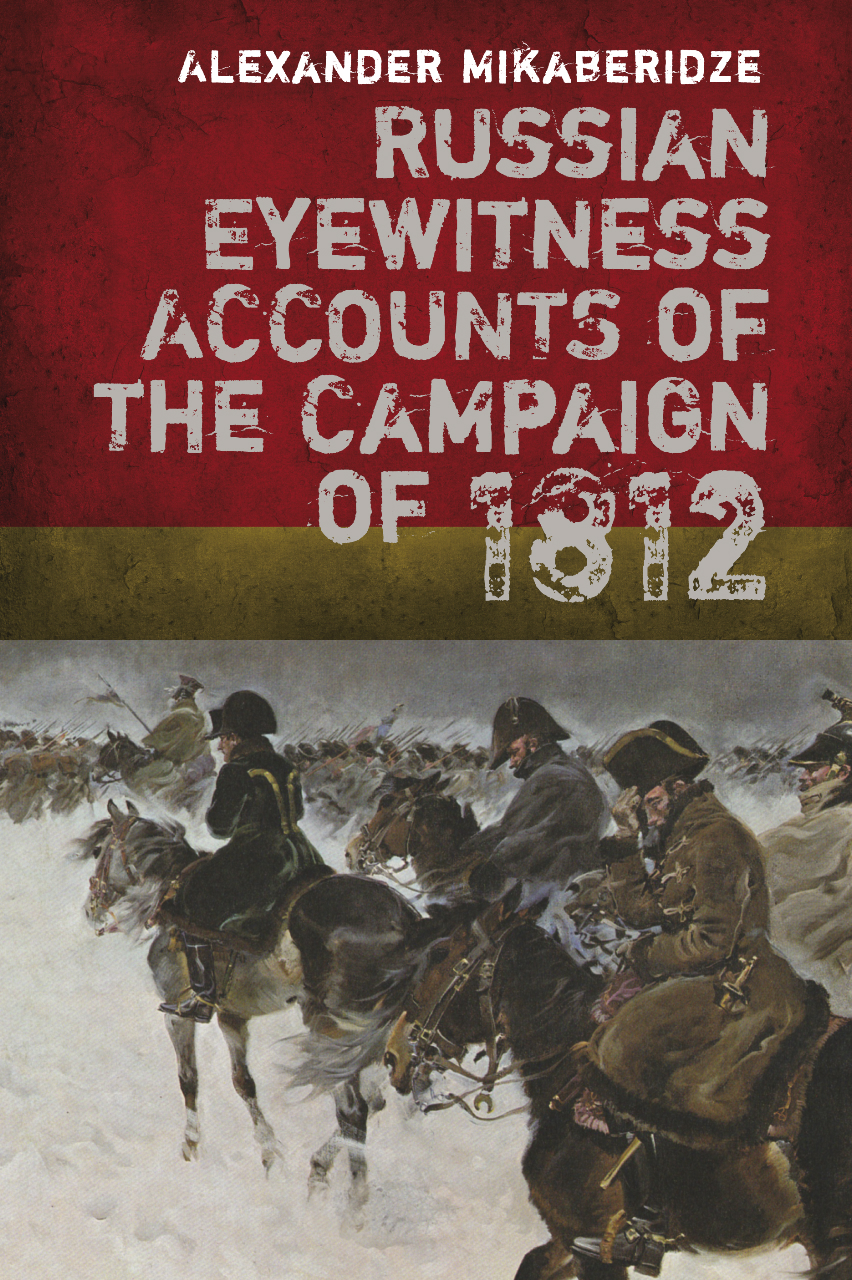
Book Review: Russian Eyewitness Accounts of the Campaign of 1812, by Alexander Mikaberidze 
(Images courtesy of the publishers. Please do not reproduce without first seeking permission)
This is another fine offering from Alexander Mikaberidze; although in this case more as an editor, and of course researcher and translator, than as an author.
The first thing that I noticed about the book was that it is written in the “wrong” order, commencing as it does with the retreat and ending with the pursuit. This is, of course, not true and is a reflection of the fact that the mind of this reviewer—and I’d wager the minds of most readers of this review—are accustomed to considering the 1812 campaign from the French viewpoint. I am sure that the chapter headings were selected, at least in part, to emphasise this key point of difference between this book and others about the campaign; it is written entirely from the Russian perspective. The book truly provides “...an unique insight on the Russian side of the war...”.
In the manner of presenting the material from the eyewitnesses, Mikaberidze has used the same approach as Brett-James did in his 1966 landmark book “1812: Eyewitness Accounts of Napoleon's Defeat in Russia”—complete, often long, largely unedited quotes from selected eyewitnesses. This provides the reader with a far more detailed and deeper reading experience than the more common approach of shorter, edited quotes interspersed with text from the author. Importantly, the eyewitness accounts presented in the book provide a range of points of view from the Czar, his generals, officers and their staff, to ‘common’ soldiers and civilians.
There are numerous interesting insights and snippets from the beginning of the war to its victorious end for the Russian forces. These include impressions of the coming war—from excitement to apprehension, a patriotic song sung by the Russian troops—in French!, detailed recollections by Ivan Zhirkevich of 2nd Light Company of Life Guard Artillery Brigade of Kutusov and his staff during the pursuit and, of course, the Battle of Borodino.
Thirty-eight pages are dedicated to accounts from the battle. Tragic, almost poetic descriptions, such as from Ilya Radozhistskii, a lieutenant in the 3rd Light Company of the 11th Artillery Brigade of 6th Corps, describing the night of 6th September “the fires turned the dark clouds in the sky into a crimson twilight and the flames in the sky foretold a bloodshed on the ground” (p. 164). Mikhail Voronstov, commander of the 2nd Combined Grenadier Division, “out of about four thousand men, there were fewer than three hundred at the evening roster call and out of eighteen staff officers only three survived, and, as I recall, only one of them was not wounded” (p. 172). Sergei Mayevskii, Bagration’s adjutant, describes being ordered to see how General Rayevskii was faring at the reboubt during the height of the morning battle. “One hundred cannon bombarded it. Rayevskii, with an elated face, told me, ‘Now go back and tell the Prince what is going on here!’ As I galloped the distance of over two verstas [1.3 miles], I suffered a hit from a flying projectile and the impact was so severe that I could not regain the hearing in my ears or close my mouth for over two hours!” (p. 176). As with elsewhere in the book, Mikaberidze’s approach of reproducing long extracts provides a fuller, more descriptive and richer account.
Each quote is prefaced by a short introductory paragraph from the editor, which the provides the background to the quote and, the first time that a person is quoted, introduces who he was and his position. It is always interesting with primary sources to know how long after events took place they are writing. I would have liked to have seen an appendix with an alphabetical list of the eyewitnesses used, a brief biography of each and from where the material is derived (perhaps even with an assessment by Mikaberidze of the reliability or otherwise).
There is only one map, an overview of the 1812 campaign. While I would always like to see more maps rather than fewer, this one is clearly drawn and seems to present all of the locations that are mentioned in the text, which is always pleasing.
Prince Bagration's last charge at Borodino, by modern Russian artist A. Averyanov. One of the colour plates in the book.
The book is beautifully presented; an aspect that seems to be in common with most publications nowadays. I have the hardback edition of the book, which always adds to the feeling of quality! The print is clear, of a good size and printed on thick paper stock. There are 24 pages of plates, a little over half of them in black and white and the remainder in colour. The black and white plates include reproductions of paintings of the Czar and his generals plus ten reproductions of famous paintings of battle scenes and other events of the campaign from artists such as Albrecht Adam and Faber de Faur and Jan Chelmińiski. The colour plates are reproductions of paintings of events and scenes, plus one of Kutusov and another of Napoleon reviewing the Guard. All of the plates are reproduced clearly and allow the reader to see the detail. While many of these prints are now available on-line (from Wikimedia Commons) it is more convenient to have them in printed form and they add greatly to the overall ‘experience’ of the book.
This book will make a fine addition to any Napoleonic library.