Thursday, 20 March 2014

Boudica’s Last Battle, AD 60 (61?)

The Britons had revolted. Camolodium was burned to the ground, the IX Legion ambushed and annihilated…

Suentonius Paulinus, military commander of the province, returned to Londinium from the island of Mona where he had defeated an army of druids, to oppose the advancing Britons. Considering his small force and learning from the lesson of the rashness of Petilius (commander of the IX Legion), he decided not to defend the town, but to “..save the country as a whole at the cost of one town.. he gave the signal for departure, and embodied in the column those capable of accompanying the march: all who had been detained by the disabilities of sex, by the lassitude of age, of by local attachment, fell into the hands of the enemy” (Tacitus Book XIV: XXXIII).

“Suentonius had already the fourteenth legion, with a detachment of the twentieth and auxiliaries from the nearest stations, altogether some ten thousand men.. he chose a position approached by a narrow defile and secured in the rear by a wood…” (Tacitus Book XIV: XXXIV) and here prepared to meet the Britons.

The armies deployed for battle.

Boudica mounted her chariot with her daughters before her and addressed her troops
It is customary for the Britons to fight under the captaincy of a woman, but now I am avenging, not as a queen of glorious ancestry, but as a woman of the people, her liberty lost, her body tortured by the lash, the honour of her daughters tarnished. Roman greed has progressed so far that not our very persons, not age itself, nor maidenhood, were left unpolluted. Yet the gods are are on the side of our just revenge: one legion that ventured to battle has been destroyed; the rest have been skulking in their camps, or looking around for a way to escape. Now they stand before us, but they cannot face even the din of so many thousands, far less our onslaught and swords! Consider in your own hearts the forces under arms and the motives for this war, on this field we must conquer or fall. Such is the settled purpose of a woman—that men might fight and live, not be slaves! (adapted from Tacitus Book XIV: XXXV)
Suentonius also sought to inspire his men
Treat with contempt the noise and empty menaces of the barbarians: in the ranks opposite, more women than soldiers meet the eye. Unwarlike and unarmed, they break immediately when, taught by so many defeats, they recognise once more the steel and valour of their conquerors. It is but a few men who decide the fate of battles; and it will be your glory that you, a handful of troops, will be gathering the laurels of an entire army. Keep your ranks close, throw your pilum and employ shield-boss and gladius; let them steadily pile up the dead. Think not of plunder. Once the victory is gained it will all be your own“ (adapted from Tacitus Book XIV: XXXVI)
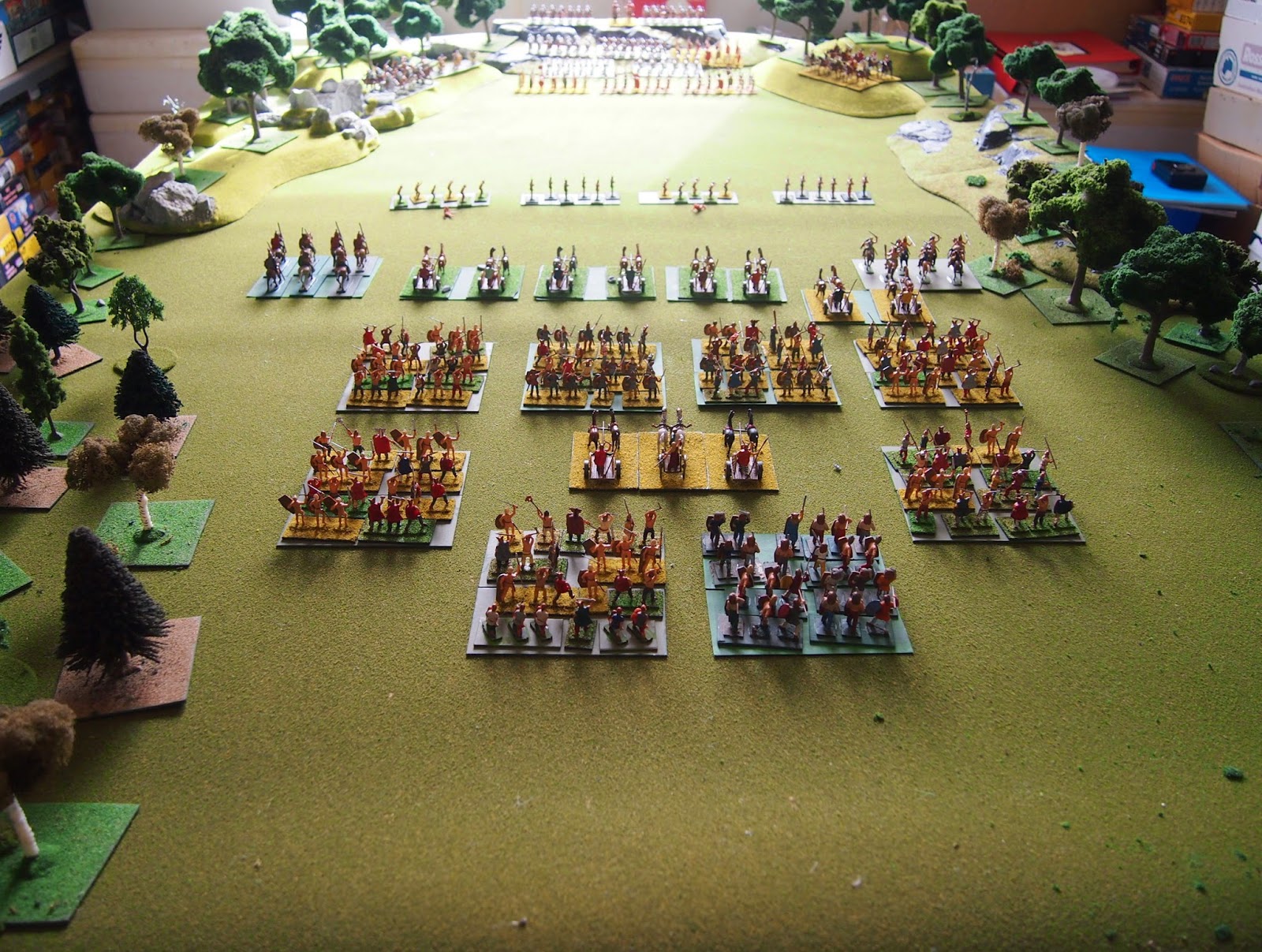
As the day’s early light dawned over the Roman position,

the Britons advanced to the attack.

Some ineffectual Roman bow fire had little impact on the approaching barbarian mass.

As Britons moved to close with the Roman line, Suentonius sent forward the auxillia to meet them.

On the Roman right, the cavalry stayed safe on their hill,

while the auxillia saw off the first of the Briton’s chariots,

…but there were many more on the way.

Above and below: after coming under fire from the Briton’s bows, the Roman cavalry guarding the left flank, went over to the attack.

Forwards came the warbands, but so too did the Romans!

Those facing the auxillia were mainly unsuccessful, but the cavalry on the Roman left were easily dispersed.

The initial attacks by her light chariots beaten back, Boudica urged her warbands to attack en masse.

They had mixed success against the Roman auxillia.

Suentonius sent the legionaries of the twentieth to support their hard-pressed auxillia brothers.

The last of the auxillia were dispersed, but the men of the XX Legion held firm.

With over half of the army slaughtered or in flight (50% demoralisation value reached), Boudica’s force turned and fled.


Mark and I played this game on 25th January, as the ANF Australia Day game for 2014. It was our second game using the Impetus rules since our original play-test. Our initial positive impression of the rules from that first outing was only enhanced by this game. They work well and suit the way that we’d like to wargame this period; larger battles based, preferably, on historical actions. Being still new to the rules and ‘rusty’ in our novel knowledge, it took us a couple of turns to remind ourselves of the mechanics, but we then got through the subsequent turns, which involved more action on the table easily and more quickly than the early ones!

References
Grant, C (1978) Boudicca’s Battle. Battle Magazine January 1978 pp. 38–40.

Jackson J (1962) Tacitus, Cornelius The Annals with an English translation by John Jackson in four volumes. IV, Annals Books XIII–XVI. Book XIV: XXIX–XXXIX, William Heinemann Ltd, London. http://www.archive.org/details/tacitusinfivevol05taciuoft

Tuesday, 18 March 2014

General de Brigade at the Napoleonic Wargaming Society

Fin de l’année 2013: 3

On 18th December, I attended the last gathering of the Napoleonic Wargaming Society for 2013. Carlo ‘Pyjamas’ kindly organised a game of General de Brigade for me to join. It was a fictitious game set in 1813 with him and Martin taking the Austrians while Phill and I had the French.

Two French brigades, supported by light cavalry, were attempting to dislodge an Austrian advance guard, deployed in outlying farm buildings and to secure the vital bridge. The Austrians needed to force the bridge to secure the river crossing.

While a bit rusty on the rules, the game went smoothly and, most importantly, was a French victory!

Here are some photos of the game, showing Phill's and Carlo's beautifully painted 28 mm figures ("giants' compared to what I am used to!!).


Early stages, French closest to camera, many brigades still on blanks. Austrians in the farm buildings in the distance.

Lead French brigade screens the smaller farm with skirmishers, while making for the one at left-rear (which was worth more victory points).

These beautiful horse gunners did not hit much!

The lead battalion of légère heading to the second farm.

My cavalry brigade advances.

Two French brigades mass for the attack on the crucial farm nearest the bridge.

The Austrian defenders await the onslaught.

But help is on its way; finally (having missed the required roll initially).

Aerial view of the battlefield; note the cavalry now 'advancing' the wrong way. Their commander panicked, thanks to a timely double one!

Command restored, cavalry heading the right way!

Above and below: the first attack goes in, viewed from the Austrian and French perspective.

The foot battery was raining merry hell on the defenders in the first farm,

...while the French skirmishers screen the main attack.

The Austrian 'cavalry' is on its way, but will they deploy in time?

Overview of the battlefield.

French attack repulsed, but the Austrians failed their formation test.

The Austrian column that had crossed the bridge was caught before it could deploy and sent packing.

The Austrian defenders between the two farms form a strong firing line.

Above and below: a second attack goes in against the rearmost farm.

This time completely successful. At this point the game was called, since we'd reached the 'witching hour'. It was a French victory, but only just!

Meanwhile on another table... This game was report by Mark (aka Marc) on is one-sided miniature wargaming discourse blog.
Thanks so much to Carlo for organising the game, to he and Phill for supplying the figures and to all three for a great game and a great night. Well worth the ~200 km round trip (I was already down in the big smoke for work!). I look forward to catching up at the club for another game in the not too distant future.

Monday, 3 March 2014

Skirmish Battle of Zwickau, 1st September 1813

Cossacks!

This was another game as part of the Campaign of Nations.


A clash of cavalry forces occurred just to the north-east of Zwickau in southern Saxony. The path of Colonel Bergmann's first division from Platov’s Cossack corps was blocked by French-Allied light cavalry (Westphalian and Württemberg) commanded by Général de brigade Bruno. The French-Allied troops had been ordered to determine the movements of the enemy and to stop or to slow them; if they could. The stage was set for a sizeable cavalry clash.

Extract from the campaign map showing the location of the clash.

The skirmish-battle took place in a broad valley with gently undulating terrain, broken by a few woods and some gentle hills towards the north/north-west.

Général de brigade Bruno’s French-Allied cavalry force consisted of his own 22nd Light Cavalry Brigade and the 24th Light Cavalry Brigade under Generalmajor von Jett. They were represented on the table by four units of French-allied cavalry. These were well supported by artillery with two horse batteries and a foot battery of 12 pounders! An artillery guard unit was formed from the sappers and train battalion.

Colonel Bergmann's division of Platov’s Cossack corps comprised four regiments. Each regiment had anywhere from 3000 to 5000 men, so, with only about 1/3 of the Russian force able to 'engage' in battle, they were represented by 11 units of Cossacks. These had ridden ahead of their corps artillery, so had no guns in support.

Victory was determined from the number of unbroken Cossack units that exited the north-east table edge, the number of turns before the last unbroken Cossack unit exited the table and the number of broken Cossack units.

In the end, these complex victory conditions were not required.

 The two sides face off, ...

 and rapidly move to contact.

 One unit of Cossacks eludes the defenders.

Two more turns of successful mêlées and accurate artillery fire (for the French-allied side) and it is all over. 

The remaining Cossack units retreat to the table edge.

Above and below: the French-allied horsemen and gunners in clear control of the battlefield

The Cossacks were unable to get past the French-Allied troops. The preponderance of guns was particularly telling, with French, Württemberg and Westphalian gunners all 'on song' (i.e. this was the most one-sided combination of my good luck and my opponent's bad luck that I've had in ages!).

Eight of the eleven Cossack 'units' were 'broken' and none were able to get past the French-Allied line. In Shako it only requires two 'hits' to break a Cossack unit, so we deemed that they have tried some attacks on the French-Allied troops and, finding that they were a tough nut to crack, dispersed to look for easier opponents.