Saturday, 7 July 2012

A fine piece of historical writing from one of the 19th C’s greatest


Book Review: Napoleon's Invasion of Russia, by Theodore Ayrault Dodge
(Images courtesy of the publishers. Please do not reproduce without first seeking permission)
Frontline Books published this extended excerpt from volume III of Theodore Dodge's Napoleon: A History of the Art of War, under the title of “Napoleon's Invasion of Russia”.
Even the foreword of this book is full of interest. Written by George Nafziger, it outlines Dodge’s amazing career. Nafziger points out that Dodge is considered to be “the greatest American military historian of the 19th century”, and I am not surprised. Born in 1842, Dodge served in the Union and US Army from the Civil War until 1870, having lost his right leg at Gettysburg. He did not begin writing until he retired, but managed, in the remaining 38 years of his life, to produce an impressive list of historical works; The Campaign of Chancellorsville (1881), Bird’s Eye View of the Civil War (1883), Parrocius and Penelope (1885, Riders of Many Lands (1894), History of the Art of War (in twelve volumes): Alexander, Hannibal, Caesar, Gustavus Adolphus, Frederick the Great and Napoleon (1889). He certainly made the most of his 66 years!
The heart of this book is Dodge’s analysis of the actions and mistakes of the key ‘actors’, chiefly focussed on Napoleon, which is only natural given he is the topic of Dodge’s study. It took me a little while to get into this book, but I found Dodge’s critique, using evidence and analysis to explore the pros and cons, engaging, interesting and insightful.
The book begins with the background to the campaign and the failed ‘negotiations’, which Dodge notes were largely for show, since neither France, Russian nor England were prepared to compromise and Napoleon’s overtures of peace were rejected outright by Russia and England. He provides an overview of the political situation, strategic movements, supply and logistics. Dodge writes at length regarding Napoleon’s detailed preparations for the campaign, which were to prove to be so drastically insufficient.
An example of one of the line drawings

Each stage and phase of the campaign is described in detail, principally from the French perspective, supported by numerous quotes and Dodge’s insightful analysis and critique. As one would expect from a book that covers the entire campaign, the battles and actions are described in strategic rather than tactical terms, with only the main movements or actions mentioned. Detailed line drawings of generals and figures from specific military units, so often seen in books published in the late 19th and early 20th century, are dotted throughout the text. These are fine pieces in themselves, add a nice touch and break up the blocks of text nicely.

One of the numerous maps: not the most elegant,
but functional and  complement the text well
Pleasingly, the book features numerous, detailed maps. While these are not as clear as those we have come to expect in more recent publications, they complement the text well. All of the towns that Dodge mentions are either indicated on a map or clearly evident from the location of forces indicated on the maps. That said, it takes some effort to track the movements of the formations and this would have been greatly enhanced by the addition of arrows and the like on each map, rather than simply towns, roads and rivers. One can hardly criticise the book for this though and I am pleased that the publishers have reproduced it in the original format with original maps.
His description of the great battle of Borodino provides an excellent overview of the battle and its phases. Dodge provides a clear overview of Napoleon’s plan of battle, an aspect that seems to be all too often missing from other accounts that I have seen. The grand tactical view of the battle does not make it any the less compelling to read, with Dodge painting a fine word picture of the colossus struggle. “This massing of men and the tremendous array of guns opened the way for frightful losses” (p. 157). Contrary to many authors and commentators, Dodge’s conclusion about the battle, and particularly Napoleon’s decision not to use the Guard, is that it was justified at the time based on what Napoleon knew of the situation, but, with the benefit of hindsight and knowledge not known to Napoleon, was incorrect (pp. 166–171).
Dodge’s overall thesis is that Napoleon’s failure in 1812 was principally a result of his uncharacteristic indecision and, at crucial times, lack of action.
“All this may sound hypercritical; but we must try Napoleon by his own standard; our question is how far his own decrease in energy affected his power to wage war; and here he was quite behind his better days. It were absurd to explain blame his shortcomings; but his failure must be explained. There is no desire to make too much of small lapses; yet each tells its story. Something like mental weariness based on a physique no longer equal to the strain of his gigantic conceptions seems to have been at fault” (pp. 125–126).
It is a compelling argument, that has often been used in subsequent analyses. Everyone has their limit. We have a saying about people being promoted one level above their capability (which seems to happen all too frequently!). Perhaps Napoleon had reached the limit of his own capacity, which until then had appeared almost limitless. Running an army of nearly half a million men, with some ineffectual subordinates, under limited intelligence and harsh conditions, while at the same running a large empire, to which he was so central, nearly 3 000 km from home, would test anyone. The Russians were suffering similarly despite being within their home country, a point that has been brought to light in more recent studies of the campaign.
Dodge’s main criticism is of Napoleon’s decision to leave Smolensk. He argues and concludes, contrary to other analyses by Jomini and Clausewitz, that a cessation of the 1812 campaign at Smolensk would have been the best course of action by Napoleon (pp. 140-41), ready for a thrust on Moscow in 1813. This argument will continue as long as people write books about Napoleon and about the campaign. I suspect that the military man in Dodge is chief in this conclusion, which ignores the very real and important geo-political considerations that no doubt weighed heavily on Napoleon’s thinking.
Interestingly, Dodge suggests that, despite the poorer supply situation of the French-Allied army compared with the Russian, Napoleon should have followed up and attacked Kutuzov again after Borodino (pp. 183–184). This may well have been successful, given the strong performance of the Grande Armée at Borodino, which in no way reflected conditions of poor mounts and poor supply. Perhaps Napoleon feared another battle so soon after Borodino for fear of the losses that would be incurred on his already reduced army, or he was still shaken by the losses at Borodino (and in fact all of the battles of the campaign so far) and did not wish to engage in another slog, or he truly believed that Alexander would sue for peace once Moscow fell, or perhaps he had even lost faith in his own ability to beat the Russians in an open battle? Dodge concludes that the lack of a follow-up battle was due solely to the poor victualling of the Napoleon’s army.
It is often indicated that Napoleon was forced back to the invasion route during the retreat due to the inclusive result of Maloyaroslavets, but Dodge suggests that Napoleon’s movement south was a deception designed to initially disguise the retreat and that “he proposed to retire by way of Smolensk, for although the country was eaten out, yet the amount of supplies which had been accumulated on this road, and were still being wheeled up, would be the equivalent of all that they could get on any, except a route much further south” (p. 203).
The latter stages of the retreat, Krasnoi, Ney’s rearguard and the crossing of the Berezina are covered in detail and make for compelling, if harrowing, reading. There is little mention of the hardships and losses encountered by the Russian army during the retreat of Grand Armée, but the hesitation, poor information and bad decision-making of the Russian generals is stressed, as this, combined with the generally good performance of Napoleon and his generals when cornered—and some luck—assisted the Grande Armée to escape complete destruction, particularly at the Berezina.
The book concludes with a reproduction of Napoleon’s 29th bulletin in full. As Dodge notes, “whatever its prevarications, in view of the fact that those were not the days of special war correspondents and telegraphs, and compared with the reports of other unsuccessful campaigns by the commanding generals, it will hold its own”. It is salutary reading and is a fine way to conclude what is a fine book.

An epic tale brilliantly told


Book Review: Napoleon in Russia, by Alan Palmer
In this bicentennial of 1812 I have focussed much of my recent reading, surprise, surprise (!) on books about the Russian campaign. This has been particularly useful as we plan for our big Borodino bash in September and for the games based on other battles from 1812 that I hope we will do after that.
I began by re-reading this old favourite, which I first read about 20 years ago. I remembered it as an engaging read that challenge some of the mythology about the campaign. I particularly remember that Palmer discussed the burning of Moscow in some depth, trying to conclude just who was responsible.
My recollection of the book was supported from the first page. Palmer tells the story of the Russian campaign in lucid and elegant prose and the book is an enjoyable and interesting read. I was impressed by his critical, yet objective approach. There is little judgmental language or value-laden statements, merely a presentation of information and quotes from some of the key actors actors to inform the reader—and tell a ripping yarn at the same time.
Unlike many books about the Russian Campaign, this tome focusses more attention on the first half of the campaign (up to and including the capture of Moscow and the great fire). The first ten chapters cover this part of the epic story, with one devoted to Maloyaroslavets, three to the retreat and a concluding chapter (‘Laurels and Legends’).
Palmer presents a story of mistakes and lost opportunities, of uncharacteristic inaction and indecision by Napoleon, of a slow-moving attack and a wily, increasingly co-ordinated and determined retreat and defence.
The pursuit of the retreating Russian armies reads like an exciting mystery-adventure. The mistakes made by Napoleon and his subordinates, especially Jérôme, and the missed opportunities at Drissa, Vitebsk and Smolensk are clearly evident to us in hindsight, and from the comfort of an armchair! Palmer does not merely critique the French, illustrating that both armies lacked a clear plan of campaign, were racked by squabbles amongst senior commanders, lack of trust, a lack of clear information, slow rates of march and the hardships of the advance/retreat, particularly the impact of the rain and heat. A key turning point was the ‘need’ (and demand) for a ‘true’ Russian commander to unite the armies and build on the patriotism, which lead Alexander to reluctantly appoint Kutuzov as C-in-C.
The chapter on the Battle of Borodino describes the main phases of that terrible encounter. It includes an excellent, relatively simple map with the main features shown clearly. As with the rest of the book, Palmer’s vivid account highlights the intensity of the struggle. He uses the battle to develop his thesis that it was an example of a change in Napoleonic warfare and a move to artillery dominance that would be so evident in WWI. I struggled with this selective use of evidence to try to develop a general thesis (not to mention that, like the European military of the mid-19th C, he omits to note the significance of the ACW), but it did not detract from the value of the book and the narrative of the battle.
As is my all-too-common beef when reading and reviewing these books, the maps do not adequately support the text. While, as indicated by my praise of the one of the Battle of Borodino, those that are provided are clear and with reasonable detail (Campaign of 1812 (endpapers), Crossing the Niemen, Battle of Borodino, Burning of Moscow, Leaving Moscow and Crossing the Berezina), they are insufficient to follow the campaign in detail.
Palmer’s book features detailed accounts of aspects of the campaign that are too often glossed over by other authors. The meeting of the Russian commanders at Fili leading to the crucial decision to retreat beyond Moscow; the burning of Moscow (about which he presents compelling evidence that Rostopchin was the perpetrator); events during the French occupation and Napoleon's attempts to deal with Alexander; the battle of Maloyaroslavets (highlighting the performance of Dokhturov, Raevski and Eugène—which lead me to muse, “what if Eugène had been at Waterloo rather than Jerôme?!”) and dramatic battles around the crossing of the Berezina. There are numerous insights and interesting observations in these sections and chapters. For example, Napoleon’s decision to leave the army once safely in winter quarters, which he made early in the retreat, the losses in the retreat prior to snow fall, how half-starved French troops fought well at Viasma, but after battle part of Davout’s corps broke and ran to protection with Ney’s. These all add to the value of this book and, given that it was published in 1967, represent one of the first attempts—in popular writing in English—to dispel the myths that had been built around the campaign since 1812. 
So, my verdict has not changed much in 20 years. I still think it is an engaging read. I was particularly impressed that, like all good story-tellers, the author’s view-point is not important—in fact we are left unsure as to his point of view—the book is about the story, the available evidence and is an attempt to present a ‘factual’ account. Another one that is highly recommended.

Wednesday, 4 July 2012

Still No News Of La Pérouse


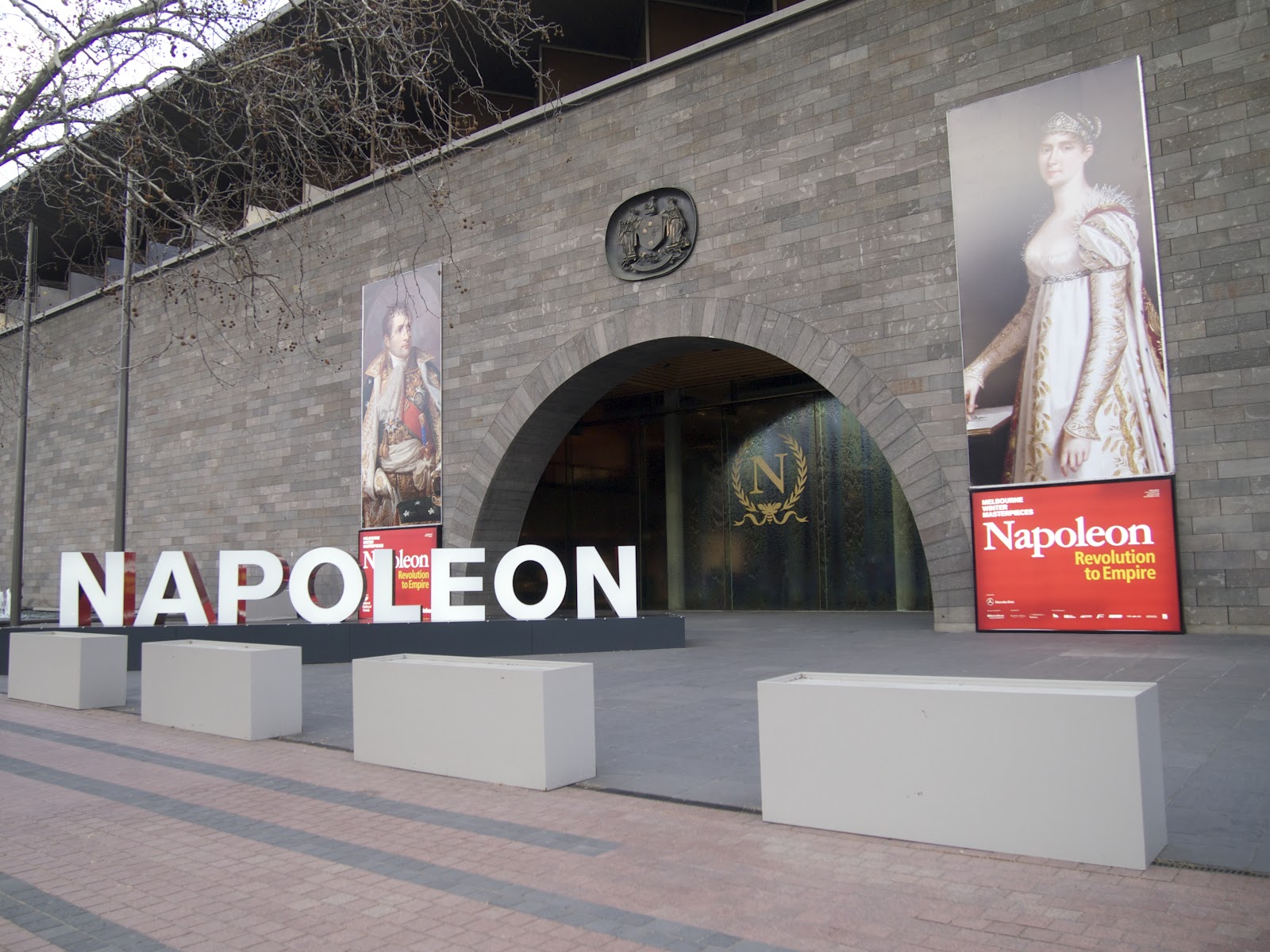
Reflections on the Napoleon Exhibition
What a sight for any Napoleon buff, to come to an Australian city and see banners of David's famous, romantic and stylised painting of Napoleon crossing the Alps!
Napoleon a envahi Melbourne
That's what greats a visitor to Melbourne at present and will do so until 7th October. The exhibition, Napoleon: Revolution to Empire, is showing at the National Gallery of Victoria and commenced on 2nd June.
Approaching the National Gallery of Victoria from Flinders Street

Entrance to the gallery
In the foyer: N in a setting perhaps more reminiscent of Josef S.?!
The exhibition focusses on art and design, and the changes in them from the Ancién Regime to the Revolution, then on to the Directory, the Consulate, the early Empire and finally the end of the Napoleonic period. It features paintings of people and events, articles of fine tableware, furniture and decoration, books, a combined twelve-hour and decimal clock, decorative swords and firearms that were presented to Napoleon and by Napoleon as gifts. Other impressive displays are a beautifully preserved dress worn by one of the lady guests at N's coronation, a series of six scenes showing aspects of the coronation and the presentation of the eagles at the Champ de Mars, a cabinet containing several crosses of the legion of honour from second to fourth class, and two cases of 'necessaires'—travelling cases with all of the needs for the well to do gent or lady.
The changing image of Napoleon himself runs through the exhibition.
Exploration, science and 'discovery' are also a major part of the exhibition, particularly the Australian connections associated with the voyages of La Pérouse, D’Entrecasteaux and Baudin, plus Josephine’s collection of antipodean plants at Malmaison. Prior to visiting the exhibition, I had no idea that Josephine was the first person to successfully breed black swan’s in captivity.
My favourite room of all, unsurprisingly for someone "like us", was the last, focussed as it is largely on Napoleon’s "art of war". The centre-piece is a large display case containing some of the uniformed mannequins as well as several items of uniforms of troops from Napoleon's army from the Musée de l'Emperi in Salon-de-Provence near Marseilles. Unfortunately the entire collection is not there (!), but a good selection is presented nonetheless. There is an officer of the 5e Hussars, a grenadier à pied de la garde, Davout's undress coat, Massena's marshal baton and case (which even has his name on it in gilt lettering), a helmet & cuirass of a post-1810 carabinier, a red lancer’s czapka, a Young Guard officer's shako, an aide de camp's decorative sword, an oriental sabre give to Ney by Napoleon and a highly decorated set of carbine, two pistols and associated powder flasks and ram-rods that were given to Massena by the First Consul in recognition of his victories in the first Italian campaign. The room also contains furniture from Fontainebleau, a dramatic painting by Charles Thevenin (see below), an early eagle and one of 1815, Empress Marie Louise’s imperial jewellery, one of N’s undress coats of a colonel of the chasseurs à cheval de la garde that he wore at St Helena, one of N’s hats, and his throne—with the N cypher removed following the restoration.
I was amazed and pleasantly surprised that I had not previously seen any of the five paintings of battle scenes that are dotted throughout the exhibition. The first of these is of the storming of the Bastille and arrest of Governor Launay (Prise de la Bastille et arrestation du gouverneur M. de Launay, le 14 juillet 1789) by an unknown artist. This is less dramatic and violent than other paintings of the event, but shows a range of groups including the ‘mob’, the Swiss Guards and white-coated infantry, as well as an impressive cannon.
The second was the Battle of the Pyramids by Francois-Louis-Joseph Watteau (La Bataille des Pyramides, 21 juillet 1798). While not the most realistic representation of the battle, it is an interesting piece in which the artist crammed as much as possible including the Great Pyramid, the Nile, a confused battle, and an interesting representation of Napoleon in profile on horseback.
There are two versions of the Battle of Marengo. Firstly, the combined effort of Joseph Boze, Robert Lefevre and Carle Vernet which the notes suggest was completed to win favour with the First Consul. It features Napoleon and Berthier larger than life, with a representation of the battle in the background. The second is a fabulous version by Jacques-François-Joseph Swebach (Swebach-Desfontaines). This does not appear to be a painting of the battle at all with its focus on the French commissariat and artillery in a peaceful setting in the foreground moving towards the distant battle. Again, this is unlike any representation in other works on this battle, but is a wonderful piece of art that shows some really interesting details of the rear lines—and none of the expected aspects of the battle!
My favourite in the entire exhibition is Charles Thevenin’s fabulous painting of the storming of Ratisbon. This work captures the chaos and confusion of battle and the seemingly impossible task of the frontal assault. Marshal Lannes is in the central location encouraging the grenadiers while being held back by his aides. In the background the main attack is making in-roads into the town. The description in the exhibition noted that Thevenin took advantage of the painting to shows as many uniforms as possible.
All in all, I thought it was a fabulous exhibition, albeit quite 'traditional'. It predominantly comprises static displays of the wonderful pieces described above, with a short description to the side. There are videos of the interior and grounds of Malmaison, Fontainebleau and Versailles and a wonderful audio extract of music from the Coronation, which was found in an attic in 1985! I’m not one for meaningless computer glitz, but I think it would have been great to have included some ‘tasteful’ CGI (representing the coronation perhaps?) or a video of a re-enactor loading and firing a musket or rifle. I would also have loved to have seen a 12 pounder as a centre-piece of the Art of War section, but I have to be a bit realistic, I guess!
The first time I went with a few members of my family who had all gathered in Melbourne. I got a multi-entry ticket for my father and me, who are the Napoleon ‘buffs’. This was great value as we had the time to make five visits over three days of a ‘long weekend’, which meant that we could have a good look at everything more than once and linger long at exhibits like Thevenin’s painting. It also meant that I was able to attend a special night-time session that happened to be on while I was still in Melbourne.
Well done and thanks to the organisers at the NGV, to the Foundation Napoleon and the various supporting individuals and companies for bringing the exhibition to Australia. The staff and volunteers at the NGV do a fabulous job of making visitors feel welcome and they seem genuinely excited about the exhibition!
Discussing tactics with the Great Man


The modern technology did not seem to impress him! 


Tuesday, 3 July 2012

Wargaming Borodino 2012 (4)


We have now 95% completed our terrain for Borodino and are pleased with the result.


Cutting and painting the hills


Casualties of wargaming


The last five percent to complete includes:
  • one last check of any areas for re-flocking,
  • re-doing a couple of hills for which we stuffed up the scale—the Utitsa Mound is currently a grassy knoll!,
  • add the Borodino Church (we’ll try a scratch built one and will purchase one if we don’t get it to our liking), and
  • place the woods.
We will get together sometime over the next couple of weeks to finish this.
Terence Wise's article about his refight of Borodino at 1:100 in Battle Magazine circa 1978

Monday, 2 July 2012

Easily the best single-volume treatment of the subject in print


Book Review: Napoleonic Artillery by Anthony L. Dawson, Paul L. Dawson and Stephen Summerfield
This book is like an encyclopaedia of artillery in the Napoleonic wars. It is all there. The book begins with an introduction to Napoleonic ordnance, and follows with chapters on Austrian, Prussian and Russian ordnance, French and French-allied ordnance, British and Hanoverian ordnance, foreign and captured ordnance, light and mountain ordnance, siege, coastal and garrison ordnance, moving the guns, colours of artillery pieces, effectiveness, characteristics and supply of ammunition, artillery tactics and artillery organisation.
It is not a book that one is likely to read from cover to cover, rather "dipping" into it to check a particular aspect, to read a section or chapter of interest, or to answer a question. (I'll confess here that I have not yet read all of the book). That said the text is eminently readable.
Do you have a question regarding the colours of the artillery guns and limbers of various nations, the range of cannon of different calibre, or regarding artillery tactics? The answer is here. Perhaps you want to know when the British adopted the block-trail carriage? You guessed it. Better still, the information does not consist merely of a statement, but with dates, references and supporting evidence.
The text is accompanied by clear and detailed diagrams of artillery carriages, barrels, limbers and equipment, photos from museums and re-enactors, paintings and line drawings, plus numerous tables.
This is a feast of wonderful information for the wargamer or general enthusiast. Turn to any page and you’ll find interesting information, well presented and clearly written. Highly recommended.
(There are known errors in the text which are chiefly typos and errors in the headings of plates. Some of these are fairly significant, but have been published by the authors on the Napoleon Series website: http://www.napoleon-series.org/reviews/military/c_NapArtyCorrections.html).

Thursday, 21 June 2012

Wargaming Borodino 2012 (3)

Preparing the Terrain, Part 1
At our most recent ANF session we forewent a game to spend the day working on our terrain for Borodino.


We had eight 1 200 x 1 200 mm2 sheets of foam to use to cover the 4 800 x 2 000 mm2 table. At first I envisaged that we’d cut them into 400 x 400 mm2 squares, but saner heads (i.e. Mark and Julian) prevailed and we decided to cover the area using four of the sheets as they were, while cutting the other four down to 1 200 x 800 mm2 rectangles; thus reducing the amount of cutting and less-than-perfect straight edges.
Our next decision was the extent and orientation of the map. Our ground scale of roughly 1 mm to 2 m gives us an area of about 9.6 x 4 km2. We orientated the table to run roughly north-east to south-west on the longest axis, so that it extends to take in the woods north-east of Gorki and stretches south-west from Utitsa. We’ll keep the table-top simple, representing only the key features.
Map of our Borodino tabletop
Having marked these on the foam sheets, we commenced by roughly painting on the base colours; green for the majority and red-brown for roads (we would have done blue for the Kolocha Stream, except that I forgot to bring the blue paint).

Step 1: marking on the roads and Kolocha Stream
Step 2: base colours painted on some of the sheets
We had a range of flocking materials (commercial flock, coffee grounds and dried tea leaves) in greens and browns, so sprinkled these on one of the sheets on which we had sprayed a dilute PVA spray. This gave a clumpy effect, so we made up a mix and then repeated the process for another two of the sheets.
Step 3: flocking
We got about half-way there before we ran out of paint and flock, so will finish it at our next session on 1st July.
Borodino terrain; about half-way there


We gave some of the troops troops preview and were happy with the result. 
Russian cuirassiers and French infantry testing the terrain (Mark and Julian’s figures)
A closer look at those Russian cuirassiers
Lifeguard cossacks (more of Mark’s great painting)
Three units of French légère (figures from P.T. Hine, one of our ‘benefactors”; scratch-built ‘duck’ (eagle) and touching up by yours truly)

Saxon heavy cavalry with the relevant page of the Histoire et Collections book “Borodino–The Moskva: The Battle for the Redoubts” as a backdrop

Tuesday, 5 June 2012

More Bicentennial Activities

While I compile a report about our latest games at the ANF—two versions of Bailén using two sets of rules—I have put some more links to bicentennial games that have been organised by wargames groups across the world on the Wargaming Waterloo 2015 blog.


Our own contribution to things bicentennial, and in particular 1812, will step up a notch this weekend. We are going to settle on our game map and begin to build the terrain for our Borodino game in September. There's a bit to do to cover the 4.8 m x 2 m table that we'll be using. Another enjoyable 'chore', like all those in our wonderful hobby!


In readiness for terrain-making: foam sheeting at ANF HQ